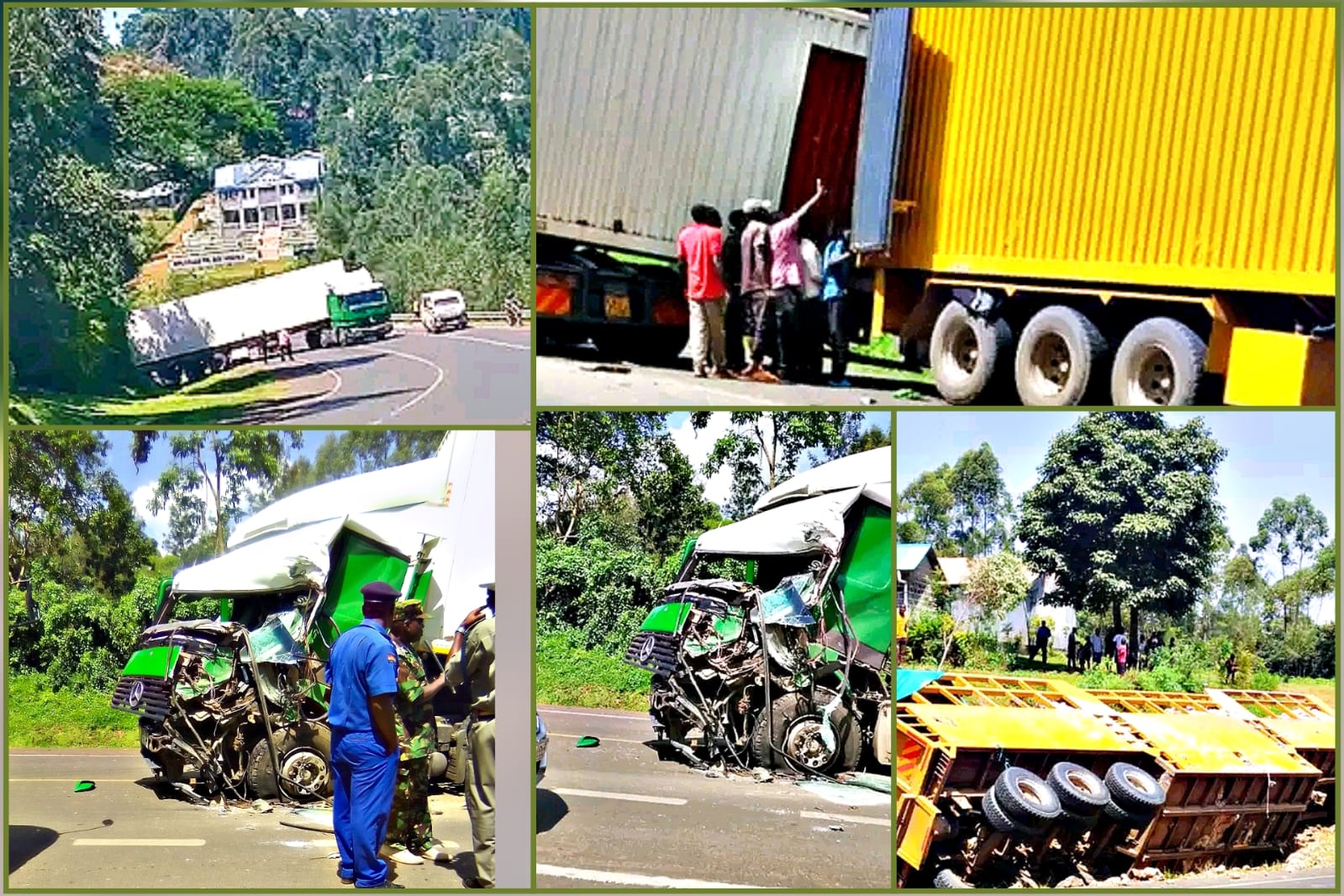
A traffic nightmare unfolded on the Mbale–Mhedwe highway after a trailer truck lost control, stalled in the carriageway and later became the focal point of a second, more damaging collision. The first truck skidded and halted in the middle of the road; no one was hurt in that initial incident, but the stalled vehicle blocked a critical lane and set off a chain of events that left other drivers with little chance to escape.
As the stranded trailer awaited transfer of its load, the owners brought in a second trailer to offload goods. During the cargo transfer, no clear warning signs or traffic diversion measures were placed along the stretch, residents and witnesses told our reporter. Officers at the scene were reportedly occupied with securing the load, leaving approaching traffic from the Kakamega–Kidumu direction without guidance.
The sequence of events at the scene unfolded as follows:
- A trailer truck lost control and stalled in the middle of the Mbale–Mhedwe highway.
- A second trailer was brought in to offload goods; no warning signs or diversions were placed.
- A loaded trailer carrying animal feed approached downhill and could not brake in time.
- The incoming trailer struck the stalled vehicle, clipped a Probox and overturned by the roadside.
- The Probox driver was rushed to hospital; the trailer driver escaped without injury.
- Police cordoned off the stretch and recovery teams began towing the damaged vehicles.
Official Response
Traffic police and emergency crews moved to the scene to secure the area and assist the injured. Officers cordoned off the stretch while recovery teams worked to tow the damaged trailers and clear debris. A police spokesperson confirmed one person had been taken to hospital and said an inquiry into the sequence of events and any possible negligence had been opened. Authorities have not yet shared detailed findings on driver fault or whether formal traffic warnings were issued before the second impact.
Local transport officials told our reporter they were monitoring recovery operations and would inspect the site for any safety improvements. Towage continued into the evening as traffic slowly resumed under escort.
Community leaders and transport unions have called for a public briefing on the incident and urged the county to establish clear protocols for handling stalled heavy vehicles on busy highways.
Why This Matters
The Mhedwe incident shows how quickly a manageable breakdown can escalate into a dangerous pile-up when caution and basic traffic control are missing. Road users on the Mbale–Mhedwe highway — a vital link for goods and commuters — face higher risks when stalled vehicles are not marked or traffic is not diverted safely. For small vehicle drivers and boda boda riders, surprise obstacles on narrow stretches and downhill approaches leave little margin for error.
- One person hospitalised after a Probox was hit during the chain-reaction collision.
- Disruption of commerce, school transport and commuter flow along the Mbale–Mhedwe highway.
- Economic and social strain on families and traders who rely on timely transport.
- Renewed calls for warning protocols, lay-bys and enforcement at known high-risk descents.
Beyond immediate harm, such incidents slow commerce, delay school and work commutes, and strain local emergency services. When a Probox driver ends up hospitalised and large trailers block a major route, the economic and social ripple effects are immediate for traders and families who rely on timely transport.
Community Impact or Background Context
Residents along the Mbale–Mhedwe corridor have previously complained about limited lay-bys for heavy trucks and insufficient turnouts where drivers can pull safely aside. The road's steep approaches and valley descents make sudden stops especially hazardous. Drivers told our reporter that practice on the route—such as maintaining speed through a downhill stretch to clear the climb—can become deadly if unexpected obstacles appear.
Local transport unions and commuter groups say informal recovery protocols often rely on truck owners and fellow drivers rather than systematic traffic management, raising questions about standard operating procedures when a heavy vehicle fails. Community members want clearer lines of responsibility and faster deployment of warning measures to prevent similar chain reactions.
Some community elders say the crash should force a reckoning about how the county prioritises road safety on secondary highways. They argue that steep descents and narrow stretches should be treated as priority zones for enforcement and engineering upgrades, not just after a serious incident occurs.
Transport operators and long-distance drivers in the area have also called for mandatory warning-kit requirements and faster deployment of traffic police to breakdown scenes, saying that many pile-ups involve stalled vehicles that are not properly marked. They say cooperation between hauliers, motorists and county transport officers is essential if the highway is to become safer.
Safety & Prevention
Drivers should always slow down at the first sign of obstructions and maintain safe following distances on downhill slopes. When a vehicle stalls, the priority is to place reflective warning triangles or cones upstream at safe intervals and to use hazard lights. Roadside workers and police should coordinate to provide visible diversion warnings and, where possible, temporarily stop traffic flow from both directions during load transfers.
- Slow down at the first sign of obstructions and maintain safe following distances on slopes.
- Place reflective warning triangles upstream and use hazard lights when a vehicle stalls.
- Coordinate with police to provide visible diversion warnings during load transfers.
- Report unmarked hazards and poor signage to the county transport office immediately.
Transport companies must ensure drivers are trained on safe brake use on descents and on procedures when encountering stalled vehicles. For the public, avoid stopping near recovery operations unless you can do so safely, and report unmarked hazards to traffic police immediately.
What Happens Next
Police will complete their probe into the collision to determine the causes and whether negligence contributed to the second impact. Recovery operations will continue until both trailers and the damaged Probox are removed and the highway fully reopens. The county transport office may review recommendations for improved safety at known high-risk points such as the Mhedwe valley approach. Families of the injured will likely await hospital updates while the investigation proceeds.
Details remain developing, and authorities will release further information as inquiries conclude. For now, the community waits for answers — about the cause of the crash, the condition of the injured, and whether this incident will finally trigger the road safety improvements residents have been demanding for months.
Share Your Thoughts
We would like to hear from you.
- What short-term measures would you like to see on the Mbale–Mhedwe stretch to prevent similar pile-ups?
- Should transport unions be required to provide on-site safety marshals during roadside load transfers?
- Have you encountered unmarked stalled vehicles or unsafe recovery operations on the Mbale–Mhedwe highway?
For official updates or emergency assistance, residents are advised to contact the relevant authorities.