Where Faith Meets Mystery: Inside Vihiga's Sacred Sites of Wagevere Rocks and Kaimosi Mission

In the quiet hills of Vihiga County, two remarkable landmarks stand as powerful symbols of faith, history, and cultural identity. The mysterious Wagevere Rocks in Sabatia and the historic Kaimosi Mission together tell a story that blends ancient folklore with the arrival of Christianity—drawing pilgrims, historians, and curious visitors from across the country.
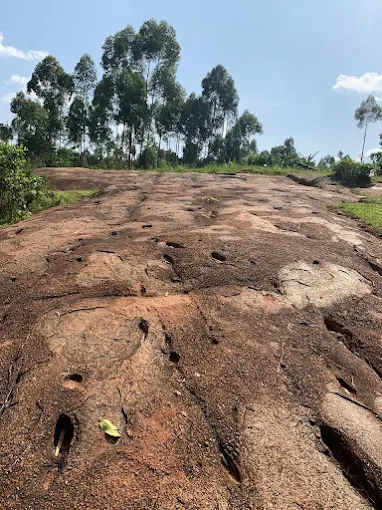
The Sacred Mystery of Wagevere "Jesus Footprint" Rock
Hidden in Gevere village near Sabatia lies one of the most spiritually revered sites in Western Kenya—the Wagevere Rock. For many locals, this is no ordinary stone; it is believed to bear the physical marks of divine presence.
At the center of the site are deep impressions etched into the granite surface. Residents firmly believe these are the footprints of Jesus Christ, with one clearly identified as his left foot. Surrounding the footprints are unusual markings resembling a machete, a padlock, and a series of numbers—2, 5, 14, and 17—whose meanings remain a mystery, often described as understandable only through divine revelation.
A few meters away lies another enigma: a coffin-shaped stone that appears detached from the ground yet cannot be moved. Local folklore recounts a chilling incident in 2010, when a man allegedly attempted to destroy the rock but died shortly afterward. Witnesses claim the stone did not crack—instead, it released a strange white, flour-like substance.
Spiritual Pilgrimage and Holy Waters
Beyond its mystery, Wagevere Rock is a deeply spiritual site. A small natural pond believed to contain "holy water" is said to never dry up. Worshippers use it for healing, cleansing, and prayer rituals. Over the years, the site has grown into a pilgrimage destination, attracting thousands—including notable figures like Margaret Kenyatta—who visit seeking divine intervention.
Kaimosi Mission: The Birthplace of Faith, Education, and Healing
A short distance away lies another cornerstone of Vihiga's identity—the historic Kaimosi Mission. Established in 1902, Kaimosi is widely recognized as the cradle of the Quaker (Friends) Church in Kenya and remains its national headquarters.
The mission's influence stretches far beyond religion. In 1903, American missionaries led by Arthur Chilson founded the Friends Africa Industrial Mission, which became the first formal school for Africans in Kenya. This marked the beginning of structured education in the region, laying the foundation for generations of learning.
Healthcare soon followed. In 1917, the mission established Kaimosi Hospital to combat diseases such as malaria and dysentery, introducing modern medical care to the local population at a time when such services were scarce.
A Living Monument to History
The Kaimosi Friends Church itself stands as a living monument to history. Originally built using mud and grass, it was later upgraded to a brick structure and continues to serve as a place of worship more than a century later.
The "Hill of Vision" and a Modern Legacy
The missionaries chose Kaimosi's location for a reason. Perched on a hill with sweeping views of the surrounding landscape, it was seen as the perfect setting for what they called the "Hill of Vision"—a place of spiritual clarity and purpose.
Today, that vision has grown into a thriving educational and religious hub. The area now hosts institutions such as Kaimosi Friends University, alongside teacher training colleges and secondary schools, cementing its status as a center of knowledge and development in Western Kenya.
"These sites represent two sides of Vihiga's spiritual identity—one rooted in ancient mystery and oral tradition, the other in documented history and institutional growth."
A Region Defined by Faith and Story
Together, Wagevere Rocks and Kaimosi Mission represent two sides of Vihiga's spiritual identity—one rooted in ancient mystery and oral tradition, the other in documented history and institutional growth.
Whether one seeks miracles, knowledge, or a deeper understanding of culture, these sites continue to shape the soul of Vihiga County—a place where belief, history, and legend live side by side.

Written by
Related Articles